Creating a Personal Brand as a CTO and Entrepreneur
Published On: Jul 20 2026
Written By: Krishnan Sethuraman
Category: Personal Brand
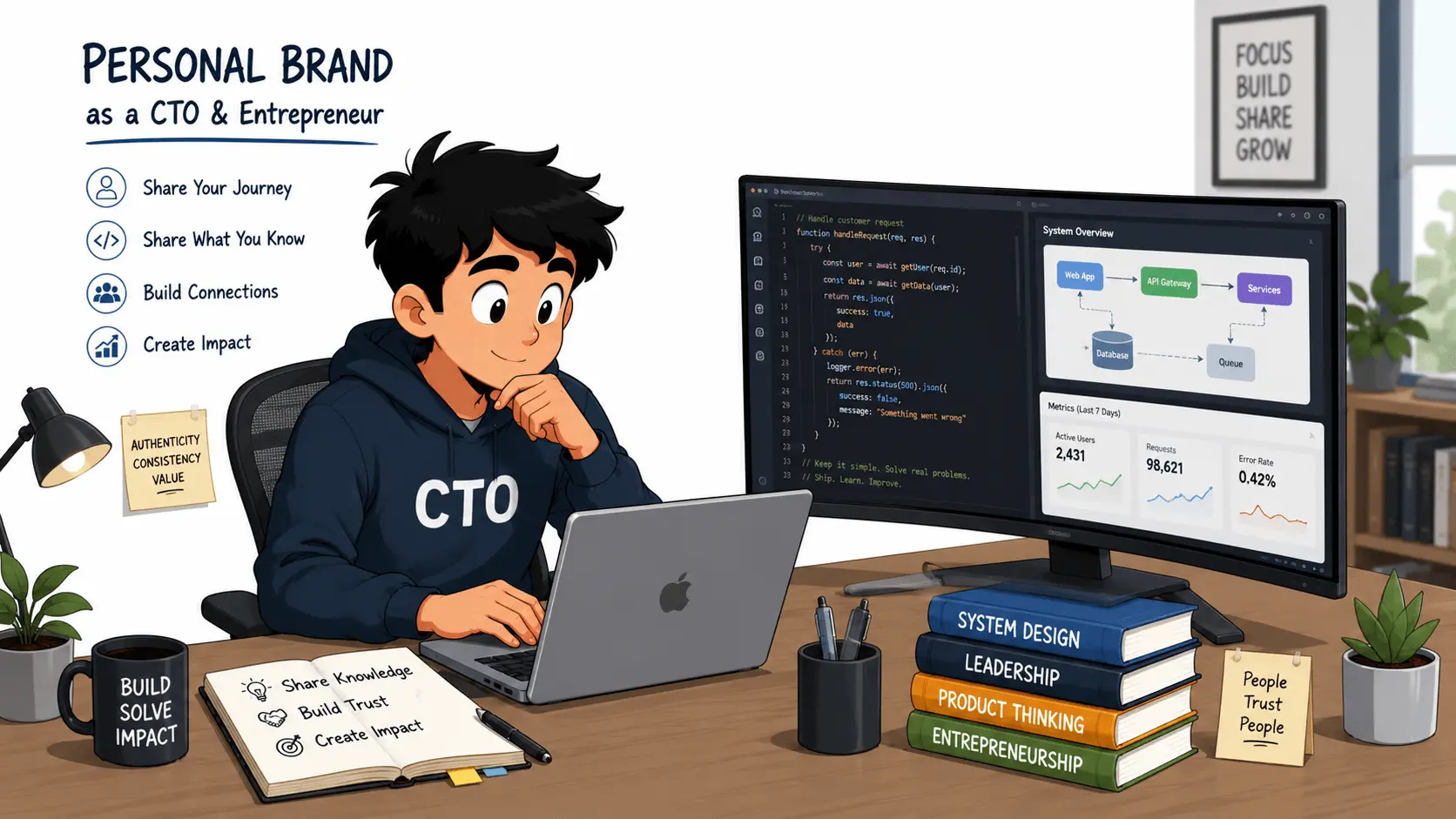
Most technical founders think personal branding is a marketing person's problem. Something you outsource once you've "made it." Something that happens after the product is built, after the revenue is real, after you've earned the right to have an opinion in public.
That's backwards. And it's costing you customers you'll never even know you lost.
Here's the uncomfortable truth: nobody trusts a logo. Nobody wakes up and decides to buy from a company. They decide to buy from a person they've come to trust — and then that person happens to work at a company. If you're a CTO who built the product, wrote the code, fixed the 2am production issue, and personally onboarded your first ten customers — you are sitting on the single most credible marketing asset your company has. And most of you are letting it rot in a LinkedIn profile nobody's updated since your last job change.
Stop thinking like an engineer marketing a product. Start thinking like a media company that happens to build software.
This is the mental shift that changes everything. An engineer markets a product by listing features. A media company builds an audience first, and the product becomes the natural next step for people who already trust them.
You don't need to become an influencer. You don't need slick production or a content team on day one. You need to understand one simple mechanic: people buy from people they trust, and trust is built through repeated, honest exposure — not through a single perfectly polished pitch.
If you're a technical founder who left a stable, well-paying job to go build something from scratch — that decision alone is content. That struggle, the sleepless nights, the moment you realized your MVP actually worked, the first time a stranger paid you money for something you built with your own hands — that's not a humble-brag. That's the exact story your future customers, future hires, and future co-founders need to hear, because it proves something no landing page ever can: you know what you're doing, because you've actually done it.
Why "Skills Beat Credentials" Is Your Unfair Advantage
There's a version of entrepreneurship that gets glamorized — the founder who raised a seed round straight out of business school, hired a VP of Engineering, and never touched a line of production code. That's not you, and that's not most of us. Most technical founders built things with their own hands before they ever built a team.
That's not a weakness to hide. That's the entire brand.
Skills beat credentials. A CTO-founder who has personally shipped multiple products — not prototypes, not side projects, actual production systems that real customers pay for and depend on — has more credibility in five minutes of honest conversation than a stack of certifications ever will. If you've built a complaint management platform that hotel chains actually use, an asset management tool that's tracking real inventory, an internal helpdesk that your own team runs on daily — you don't need to convince anyone you can build things. You need to simply show people, consistently, that you already have.
This is where most technical founders get it wrong. They think their work speaks for itself. It doesn't. Not because the work isn't good — but because nobody's looking. You have to bring the work to them, again and again, across the places they actually spend their time.
The Brand Story You Already Have (and Aren't Telling)
Every technical founder has an origin story sitting in a drawer somewhere, and almost nobody tells it enough. Not once. Not as a footnote in an "About" page. Again, and again, and again — in different formats, from different angles, until it becomes inseparable from your name.
Left a comfortable tech lead role to go build something from nothing. Spent years learning things the hard way because there was no senior engineer to ask. Personally mentored junior engineers instead of hiring seniors, because building people was as important as building product. Shipped not one product, but a portfolio of them — each one solving a real operational headache for real businesses.
That's not a resume line. That's a brand.
The mistake is treating that story as something you tell once, in an About page or an investor deck, and then move on from. Your audience isn't reading your About page. They're scrolling LinkedIn on a Tuesday afternoon, half paying attention, and they need to encounter fragments of that story — a lesson from a production incident, a hiring philosophy, a hot take on why credentials are overrated — enough times, on enough different days, that it starts to stick.
Discoverability Comes Before Trust
Here's the part technical founders consistently underestimate: it doesn't matter how good your story is if nobody encounters it. You can have the most compelling founder journey in your industry and it will do absolutely nothing for your business if it lives exclusively in your head, or in a single post that fifteen people saw eight months ago.
The real goal isn't going viral. It's being discoverable — repeatedly, across multiple platforms — by the specific people who will one day need what you build.
Think about the last time you actually trusted a founder's product because of who they were. You didn't see one post and immediately convert. You saw them once, scrolled past. Saw them again a few weeks later, this time you actually read the caption. Someone forwarded you something they wrote. Then, months later, you finally had the problem they'd been talking about the whole time — and you already knew exactly who to call.
That's the funnel, and it's not optional:
- Attention — showing up, repeatedly, across multiple touch points
- Connection — being consumed enough times that trust quietly accumulates
- Conversion — the moment your audience actually has the problem you solve, and you're the first name that comes to mind
You cannot skip to conversion. Nobody can. The founders who try to sell before they've built any of the first two stages are the ones wondering why their content "doesn't work," when the real issue is nobody had a reason to trust them yet.
Building in Public Isn't the Only Way — But Silence Isn't an Option
There's a popular narrative that personal branding means documenting every metric, every revenue number, every internal struggle in real time. That's one flavor of it, and it works for some people. It is not mandatory.
What is mandatory is showing up consistently with substance. That can look like:
- Sharing hard-won engineering lessons from building and scaling real infrastructure
- Writing candidly about hiring, mentoring junior engineers, and the mistakes made along the way
- Talking through product decisions — why you built one feature and killed another
- Being honest about the parts of entrepreneurship that don't make it into highlight reels
You don't need to be a natural extrovert or comfortable on camera. If that's genuinely not you, someone else on your team can carry some of that visibility — a technical lead, a customer-facing engineer, someone whose voice adds credibility to the brand. What matters isn't who delivers the story. What matters is that the story gets told, consistently, by someone real.
Measure the Right Things, or You'll Quit Too Early
If you start posting and judge success purely by view counts, you will burn out within a month and conclude that "personal branding doesn't work for technical founders." It's not that it doesn't work — it's that you're measuring the wrong signal.
Views are vanity. Comments, shares, DMs, and follows from the right people are the real signal. A post with 200 views and three DMs from actual potential customers or hires is a wildly successful post. A post with 20,000 views and zero engagement from anyone in your target audience is a well-produced piece of content that did nothing for your business.
Treat this like an engineering problem, because it is one. Set a hypothesis. Measure the actual outcome. Iterate. Don't confuse activity with progress.
And don't mistake consistency alone for a strategy. Posting on a schedule without ever trying anything new will get you a flat line, not growth. The founders who see real compounding results are the ones who stay consistent and keep experimenting — new formats, new angles on the same core story, new platforms — while never losing the through-line of who they are and what they've actually built.
The Compounding Effect Nobody Warns You About
In the early days, this will feel like shouting into a void. You'll write things that get almost no engagement. You'll wonder if anyone's actually reading. This is normal, and it is not a signal to stop.
Trust compounds slowly and then all at once. The person who saw your post six months ago and didn't engage might be the one who reaches out the moment they finally hit the exact problem you've been quietly talking about the entire time. You won't see that connection happen in real time. You'll just, one day, get a message from someone who says "I've been following your journey for a while" — and you won't remember exactly when they started.
That's the actual payoff of a personal brand built on real skills and an honest story: not a viral moment, but a slow accumulation of trust that eventually turns into inbound conversations, better hires, and customers who already believe in you before the first call even starts.
You already did the hard part — you built the thing. Don't let the story of how you built it sit unused.

Krishnan Sethuraman
Founder & CTO of Geedesk. Passionate about building software from scratch, launching SaaS products, and helping teams deliver enterprise-grade solutions.
Like what you are reading?
Discover more similar articles sent to your email
Subscribe to my newsletter