Notes on: The Great Unlock - India in 2035 (Nandan Nilekani, Arkam Ventures Annual Meet)
Published On: Jul 28 2026
Written By: Krishnan Sethuraman
Category: Business
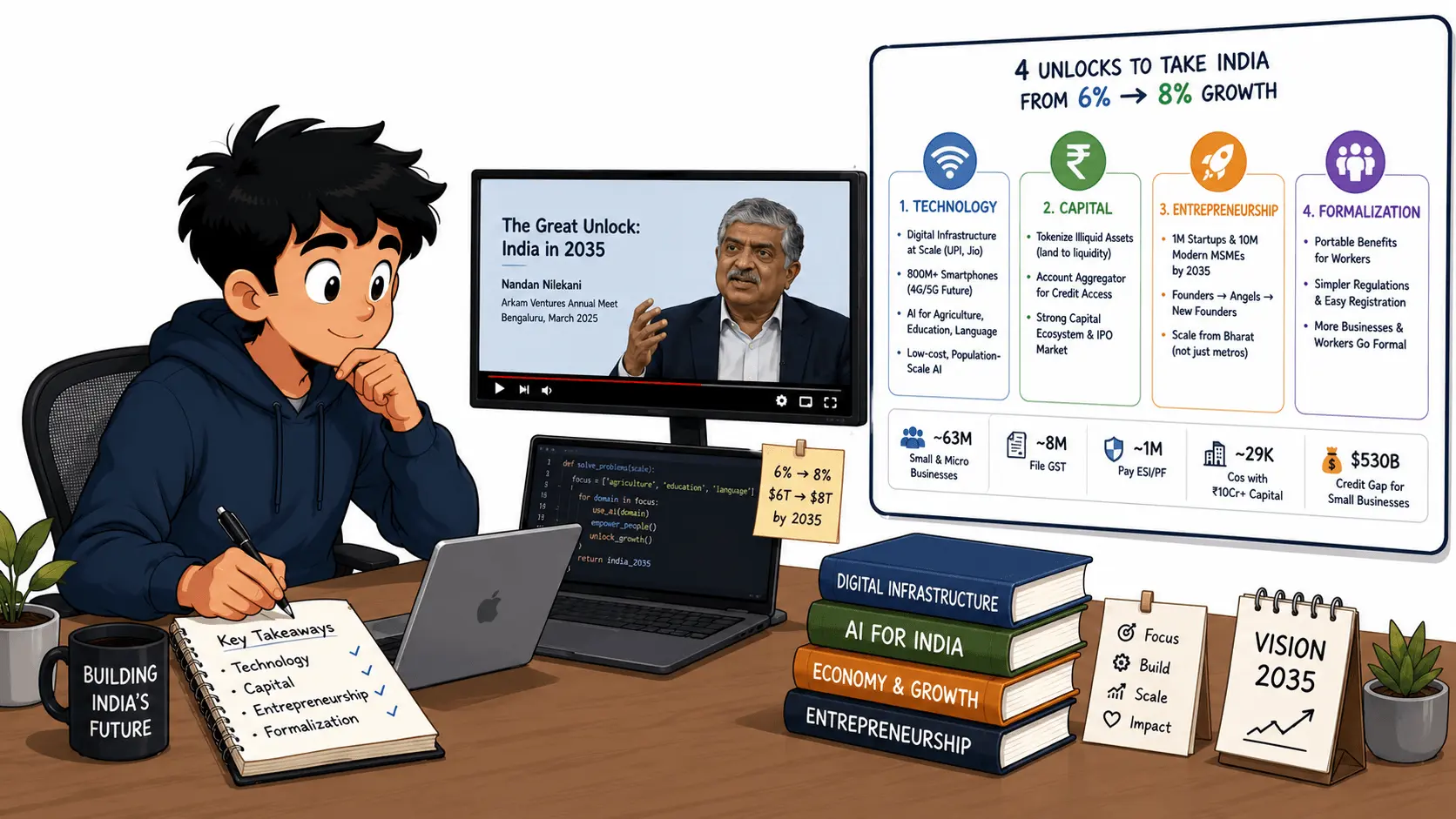
A few things I jotted down while watching this. Didn't get through the full video, so I've added a bit of extra context below on the parts I missed — flagged separately so you know what's from the talk vs. filled in later.
The setup: where India is right now
- India has been on a digitisation run — Aadhaar e-KYC alone has crushed the cost of onboarding people into the formal system.
- UPI is now the default rails for money movement in the country.
- Growth is sitting at ~6%. To get to 8%, doing "more of the same" won't cut it — something structural has to change.
The core problems, as laid out:
- Informal sector is huge, income disparity is sharp, productivity is low, market access is patchy.
- Growth is very lopsided — just 13 of 788 districts generate half of India's GDP.
- Population replacement rate averages 2.5, but it's split: north/east India runs closer to 3, west/south closer to 1.7. This gap is a big driver of internal migration — people moving from the north/east toward the west/south for work.
- ~50% of Indian wealth sits in land. Land is a terrible collateral asset in practice — hard to monetize, hard to borrow against. So the single biggest asset class in the country is largely "frozen."
- Productivity: US ~$82/hour, China ~$28/hour, India ~$7-8/hour (my notes said $78, that's almost certainly a mishearing/typo for something closer to $7-8 — worth double-checking against the video, but this productivity gap is a running theme of the talk).
- Formalisation is thin — only ~15% of the economy is formal, vs. ~60% in Brazil.
On businesses specifically:
- ~63 million small and micro businesses in India, but only ~8 million file GST.
- Only ~1 million pay ESI/PF.
- Only ~29,000 companies have paid-up capital of ₹10 crore or more.
- There's a $530B gap between the capital small businesses need and what's actually available to them.
- Net effect: lack of capital + lack of market access = stunted growth for the informal/small business layer of the economy.
The four unlocks
Nilekani's framing: four levers that could take growth from 6% → 8%, and GDP from $6T → $8T by 2035.
1. Technology
This is the section my notes cover in most depth.
- Foundations already proven at scale: Jio, UPI. 500M+ smartphone users today, WhatsApp at ~530M users in India, PhonePe at ~350M.
- Next unlock on the network side: telcos can't keep supporting 2G/3G/4G/5G all at once forever — expect 2G/3G to get decommissioned over the next ~5 years, pushing everyone onto 4G/5G. That alone could push smartphone penetration toward 800M+.
- Language is a big constraint today — most of this infrastructure works in English/Hindi. AI is expected to be the wedge that breaks this open: translation, regional language support, voice interfaces.
- The idea of "low-cost, population-scale AI" — basically applying the UPI playbook (cheap, shared, public infrastructure) to AI itself.
- Interfaces get simpler — voice-driven UPI transactions, talking to your phone instead of navigating menus.
- Concrete examples mentioned: an Open Agri Network + low-cost AI model being rolled out in phases to get information into farmers' hands directly. AI in education — apparently already happening in Tamil Nadu and elsewhere.
- Big three application areas for AI, per the talk: agriculture, education, language.
- General vibe: a lot of startups are now going after real Indian business pain points — seen as a healthy sign.
- On funding for this: angels, VCs, family offices, and public markets as the funding stack for these startups.
(This is where my notes ran out — the video goes on to cover three more unlocks in similar depth. Here's what I found from other sources so this is actually complete as a reference.)
2. Capital
- Centres on tokenizing illiquid assets (this maps directly back to that "50% of wealth stuck in land" problem — the idea is to make fragmented/illiquid assets tradeable and usable as collateral).
- Leans on the Account Aggregator framework (India's consent-based financial data-sharing system) to improve capital efficiency and get credit flowing to people/businesses who currently can't access it.
- The pitch: India already has a full capital lifecycle from seed to IPO — 7,900+ angels, VCs, family offices, and PE firms — plus a fast-growing retail investor base (100M+ unique equity investors, and roughly $24B/year flowing into SIPs). That IPO market is what lets successful startups exit and recycle capital back into the ecosystem.
3. Entrepreneurship
- The headline number: one million startups and ten million "modern" MSMEs by 2035.
- Current base is around 150,000 startups (up from roughly 2,000 in 2015) — so the claim is this is a continuation of an existing curve, not a new bet.
- The mechanism he describes is close to "binary fission": successful founders turn into angel investors (Kunal Shah backing hundreds of ventures was the example given), employees from breakout companies spin out and start their own (Flipkart alumni founding PhonePe, Groww, Spinny, Slice), and IPOs create liquidity that gets recycled into new ventures.
- Half of all startups today are outside the top 8 metros — positioned as a direct answer to the "13 districts = 50% of GDP" spatial inequality problem.
- Names dropped as examples of new-model businesses: JAR (digital savings), Anorg (street hawkers), Meesho (first-time online sellers), Urban Company and Rapido (services/gig work at scale), PhysicsWallah (ed-tech), Credit B (reaching deep into smaller pincodes).
4. Formalization
- Goal: portable credentials and benefits for workers, plus simplification of regulation to make it easier to formally register and run a business.
- Frameworks referenced elsewhere by Nilekani on this theme: ONDC (Open Network for Digital Commerce) and OCEN (Open Credit Enablement Network) for commerce/credit, and NDEAR (National Digital Education Architecture) for skilling — the broader argument being that historically it made more sense for a lot of businesses to stay informal, and these frameworks are meant to flip that incentive so formal status becomes the more valuable position to be in.
- If this plays out, more of those 63 million MSMEs move into the GST net, gain better access to capital and markets, and more workers move into the formal sector with actual benefits attached.
Some numbers worth sitting with
- Top 10% of Indians earn ~60% of national income; bottom 50% average roughly ₹71,000/year.
- ~200 million workers migrate internally each year from poorer regions toward more prosperous states — this is the flip side of the replacement-rate/migration point above.
- eKYC cost dropped from ~$23 to ~$0.50 per verification — this is the kind of infrastructure cost collapse the "AI as population-scale infrastructure" argument is built on.
Why the talk landed the way it did
Worth noting for context: this wasn't given in a particularly optimistic moment — growth had plateaued, the rupee was weak, tariff uncertainty was in the air, and DeepSeek's launch had knocked some of the swagger out of India's tech scene right before this. Part of why the talk got attention is that it came almost exactly ten years after Nilekani's well-known 2015 "WhatsApp Moment" speech, where he predicted UPI would do to Indian banking what WhatsApp did to SMS — a call that turned out to be broadly right (UPI was doing close to 17 billion transactions a month by early 2025). That track record is presumably a chunk of why this framework is being taken seriously rather than dismissed as another consultant-style deck.
Source video: "The Great Unlock: India in 2035" — Nandan Nilekani at the Arkam Ventures Annual Meet, Bengaluru, March 2025.
Video
Krishnan Sethuraman
Founder & CTO of Geedesk. Passionate about building software from scratch, launching SaaS products, and helping teams deliver enterprise-grade solutions.
Like what you are reading?
Discover more similar articles sent to your email
Subscribe to my newsletter